| THE EVOLUTION OF EXCELLENCE From Shipbuilding to Starships — 500 Years of Continuous Improvement |
| MONTHLY NEWSLETTER · OCTOBER 2026 · THE 1500s |
Where the Story Begins
The Venetian Arsenal and the Birth of Organized Improvement
Friends,
Welcome to the first issue of the monthly newsletter for The Evolution of Excellence. Each month we will walk one stretch of the 500-year story — the tools, the people, and the systems that turned “better” from a hope into a method. We begin where the book begins.
This October we open that argument where it actually starts: not with Toyota, not with Ford, and not with a twentieth-century consultant’s slide deck. It starts in a walled shipyard on the edge of a lagoon, in a republic that treated excellence as a matter of survival.
Venice in the 1500s did not invent “continuous improvement” as a slogan. The arsenalotti — the men of the Arsenale di Venezia — would not have recognized the phrase. What they did invent, refine, and defend for generations was something more useful: a system. Standardized designs. Prefabricated parts. A moving line that brought the unfinished ship to the work. Numbered stores. Specialist teams. Managed forests. Accounting that began to treat labor and material as things that could be measured, wasted, or improved. And a culture that kept changing the galley because the enemy, the sea, and the market would not sit still.
That is the first chapter of a 500-year story. From those covered sheds and canals we can draw a straight, if imperfect, line to the factories, launch pads, and digital work systems that still live or die by the same question: How do we make the next one better than the last?
— The Evolution of Excellence
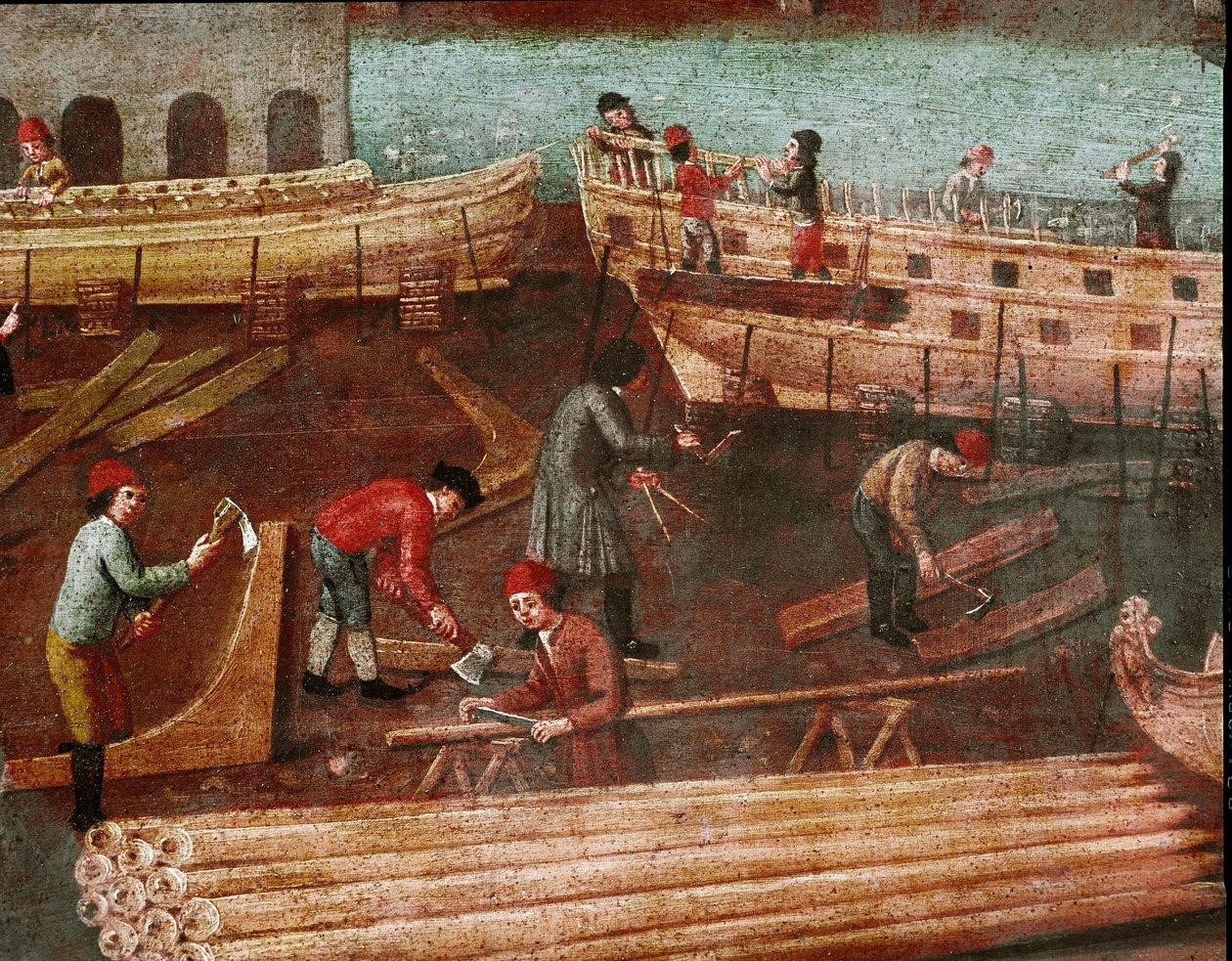
Shipyard in the Arsenal of Venice. Venetian School, 18th century (after earlier practice).
THE FACTORY OF MARVELS
Founded in the early twelfth century and enlarged across the late Middle Ages, the Arsenale was, by the sixteenth century, the largest industrial complex in Europe. Economic historian Frederic C. Lane called it “perhaps the largest industrial plant of that time.” At its peak it employed on the order of 16,000 people — shipwrights, caulkers, oarmakers, ropemakers, sailmakers, founders, storekeepers, and the clerks who counted everything. In a city of roughly 100,000 to 150,000 souls, that is not a workshop. It is a city inside the city.
The output was legendary, and the legend needs a precise edge. Venice did not grow a tree, fell it, and launch a finished warship before sunset. What the Arsenal mastered was the harder trick: decoupling the long work of making parts from the short work of assembling a fleet. Hulls were framed, planked, and stored. Oars, benches, masts, sails, rudders, cables, and guns were made to pattern and warehoused by type. When war came, the unfinished hull was towed along an internal canal. At each station a specialist crew did one job. At the last stop the crew boarded, the biscuit went aboard, and the galley was a weapon.
In 1537–38 the Arsenal rolled out some fifty hulls in ten months. When war with the Ottomans broke in 1570, Venice put an emergency fleet of about one hundred galleys to sea in roughly fifty days. In 1574, King Henry III of France was walked through the complex and watched a galley completed and fitted while he dined — a piece of state theater, yes, but theater built on a real production system. A Spanish traveler, Pero Tafur, had already described the same logic in 1436: a galley towed down a water street while cordage, bread, arms, and oars were handed out from the windows on either side. Ten galleys, he wrote, came out fully armed between the hours of three and nine.
— Pero Tafur, on the Arsenal, 1436
WHAT THEY CHANGED — AND WHY IT MATTERED
The technical hinge was frame-first construction. Roman practice had built the hull shell first and then fitted the frame inside it. Venetian shipwrights reversed the order. The skeleton went up first; the planking followed. The method used less timber, went faster, and made it possible to think of a galley as a repeatable geometry rather than a unique sculpture. Once the design was a template, parts could be cut to a common measure — il sesto comune, the ordinary measure of the galleys — instead of being tailored ship by ship.
That is design for manufacture, four centuries before the phrase. It is also the moment craft begins to become a system. The master shipwright still laid down the shape by eye and passed secrets through families and guilds. But the rest of the work could be divided: framing in one place, planking and cabins in another, final fitting on the water. The product moved. The specialists stayed. Materials traveled the shortest possible path because the layout of the Arsenal itself was rearranged around the sequence of work.
Vertical integration completed the picture. The Republic did not buy a finished navy. It grew timber in managed forests on the mainland, floated logs down the rivers, aged and sorted wood by use, spun hemp into cable in the Tana, wove sailcloth, cast guns, baked biscuit, and stored pitch. When naturally curved timber was scarce, foresters later learned to bend living trees toward the shapes the frames required. The supply chain was not a metaphor. It started in a seedling.
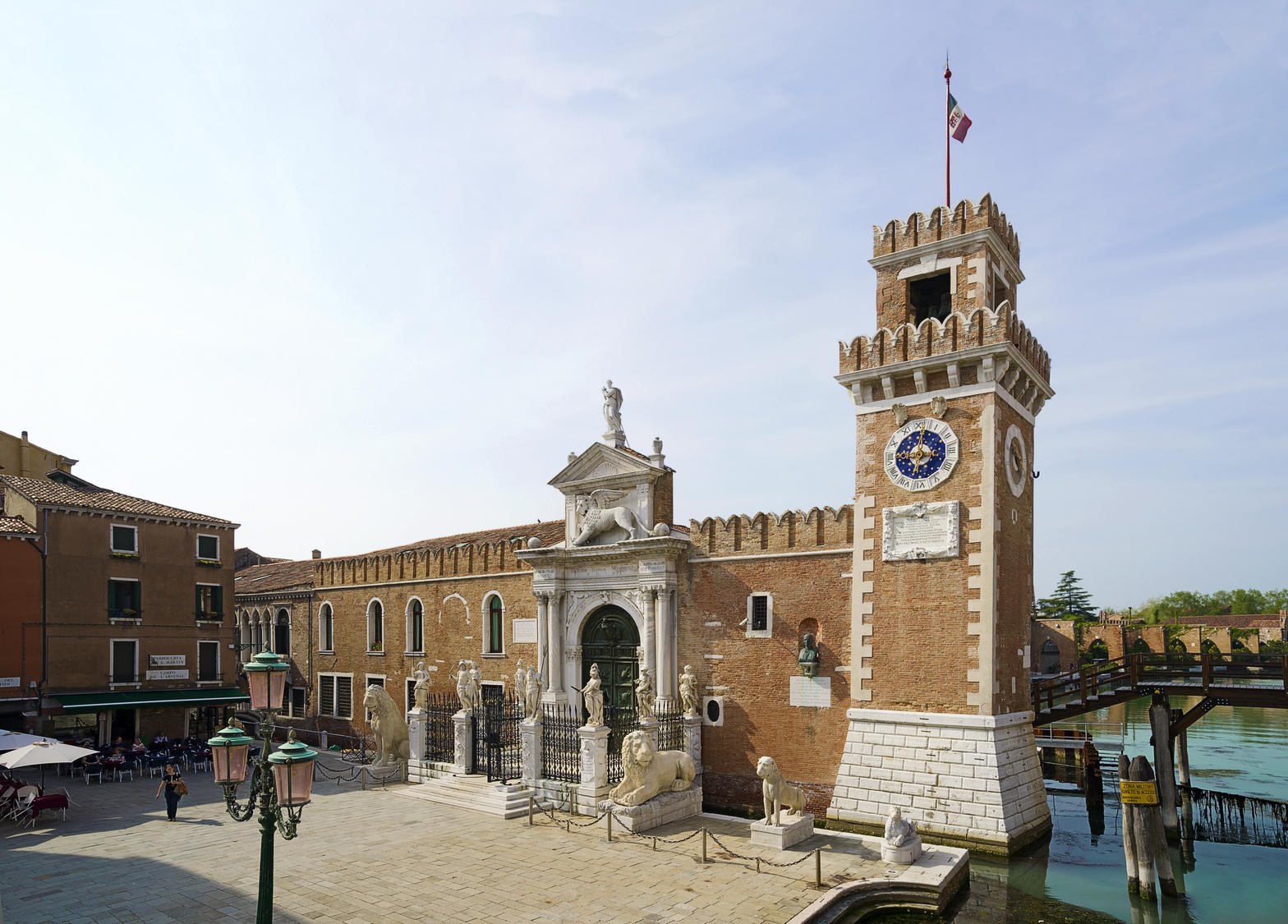
The Porta Magna of the Arsenale. The walls were not only defense. They were process control.
THE CI TOOLKIT, 1500S EDITION
We should not paste modern labels onto Renaissance practice and call the work done. The Arsenal was not Toyota. It was not Highland Park. Parts were standardized more often than they were fully interchangeable. The line was a canal and a sequence of sheds, not a paced conveyor. Workers were guildsmen, not andon-cord operators. Honesty about those limits is part of excellence.
And still, the toolkit is recognizable. If you lead a plant, a hospital, a software team, or a launch campaign, you already know these instruments. Venice simply used them first, under different names, because losing a fleet meant losing a republic.
What the Arsenal practiced
| Arsenal practice | The modern name we would give it |
| Frame-first building and a common timber measure | Standard work and design for manufacture |
| Prefabricated hulls, oars, masts, sails, benches | Modularity; make-to-stock, assemble-to-order |
| Hull towed past specialized stations on the canal | Flow production; product to the worker |
| Separate warehouses for each class of fitting | Workplace organization; point-of-use stores |
| Hulls and kits numbered and matched | Visual control and traceability |
| Specialist crews repeating the same station work | Division of labor; skill depth at the operation |
| Inspectors, state oversight, and assigned blame for defects | Quality at the source; process ownership |
| Attendance bells, late men unpaid, time discipline | Takt awareness and labor control |
| Rewards for useful innovations in method and design | Suggestion systems; respect for the improver |
| Managed forests and shaped living timber | Supplier development; long-horizon supply chain |
| Reserve of ~100 dry-stored galleys plus kits | Strategic inventory; surge capacity without waste afloat |
| Late-1500s accounts of work-in-process, cost, and layout | Management accounting; the discourse of maneggio |
Look at that last row. By the 1580s and 1590s, men inside the Arsenal were writing about maneggio — handling, management — in language that still startles historians. Baldissera Drachio and others argued for a common measure of the galleys, for separating new work from repair, for placing cut timber next to the work that needed it, for watching waste in material and presence in labor. The Venetian Senate demanded inventories and double-entry accounts of goods as they moved from store to store and changed form in the workshops. They were inventing the idea that a complex production system can be seen, costed, and improved on purpose.
A SYSTEM BUILT FOR UNEVEN DEMAND
The Arsenal’s deepest lesson is not speed. It is how to live with a demand curve that spends most years almost flat and then, without warning, goes vertical.
A galley in the water rots, costs a crew, and consumes scarce wood. A galley that does not exist cannot save the lagoon. Venice’s answer was a hybrid that operations people now teach in first-year courses: build the long-cycle pieces at a steady pace in peacetime; hold them as a numbered reserve; assemble to order when the Ottomans move. The famous “one ship a day” is the last hundred yards of that design. The first ten miles were forests, templates, warehouses, and the political will to keep producing when the harbor looked quiet.
That is why the Henry III lunch matters. It was not a magic trick. It was a demonstration that the constraint had been moved. The scarce resource was no longer the months required to invent a ship. The scarce resource was the hours required to marry a stored hull to a stored kit. When your enemy can replace a fleet, your enemy has changed the game. After Lepanto in 1571, the Ottomans rebuilt. Venice had already spent a century learning how to do the same.
CONTINUOUS IMPROVEMENT WAS NOT A POSTER
The galley itself kept changing. Gunpowder forced the issue. Oared fighting ships had to carry cannon without burying their bows. Shipwrights fattened the forward sections, refined the fish-shaped underwater body, and eventually produced the galleass — a heavier, gun-bearing hybrid that stunned the Ottoman line at Lepanto. Venice consulted the best minds it could reach. A century later the arsenalotti would ask Galileo how to place oars more efficiently. The point is not the famous name. The point is the habit: when the product meets a new environment, the design is not sacred. The purpose is.
Improvement also ran through the social system. Young apprentices entered the trades early. Masters transmitted method. The state housed key workers near the gates so the morning bell did not lose an hour to a long walk. Innovation was not left entirely to chance; useful changes were noticed and rewarded. None of this looks like a modern kaizen event. All of it looks like an organization that expected the work to get better because the alternative was to fall behind Genoa, Spain, or Constantinople.
— The Evolution of Excellence
FIVE LESSONS YOU CAN USE THIS MONTH
1. Separate the long cycle from the short cycle. Venice did not try to grow oak at the speed of a naval emergency. It grew oak on a forest clock and assembled ships on a war clock. Ask where your own work is still pretending that every step must happen in the same week. What should be made to a standard and held? What should wait for the real signal?
2. Move the work to the skill, not the skill to the work. The canal was a conveyor. Stations did one class of job. If your team still carries the whole product around the building — or the whole problem around the org chart — you are paying a medieval penalty with modern overhead.
3. Standardize the geometry before you chase speed. Frame-first construction and the common measure came before the lunchtime launch. Speed without a standard is just hurry. A standard without a way to change it is dogma. Venice had both: a template, and a reason to keep revising the template.
4. Make the system visible enough to argue about. Numbered hulls. Dedicated sheds. Inventories. Accounts of work-in-process. The late-sixteenth-century papers on maneggio exist because someone needed to see waste in order to attack it. If you cannot see flow, stock, and delay, you are managing folklore.
5. Build for the surge you hope never comes. A hundred dry hulls looked like excess until 1570. Then they looked like the price of remaining a republic. Every serious system needs a reserve that is waste in peacetime and oxygen in a crisis. Decide, on purpose, what that reserve is.
FROM THE LAGOON TO THE LAUNCH PAD
I wrote this book because the tools we treat as modern — flow, standard work, visual control, designed-in quality, supplier development, surge capacity, even the humble budget — have ancestors. Those ancestors were not quaint. They were the operating system of a maritime empire. When we get to Ford, we see the moving line made of steel and electricity. When we get to Toyota, we see respect for people joined to the war on waste. When we get to SpaceX, we see a rocket treated the way Venice treated a galley: as a product that must be flown, recovered, studied, and flown again.
But we will not understand those later chapters if we start in 1913. The 1500s are not a prologue you can skip. They are the first proof that excellence scales when a society decides that “good enough” is a strategic risk.
That is the work of this newsletter: one century, one system, one set of tools at a time, drawn from the book and aimed at the work in front of you. Thank you for opening Issue One. Stay with me in November.
| COMING IN NOVEMBER Issue Two leaves the lagoon with the idea itself: how accounting, measurement, and workshop discipline begin to travel with European power — and how improvement, once it can be written down, becomes something that can be copied, stolen, and raised. The book is on Amazon. This newsletter walks it, month by month. The Evolution of Excellence: From Shipbuilding to Starships Available on Amazon · William J. Clayton |
Build the next one better.
William J. Clayton
Author, The Evolution of Excellence