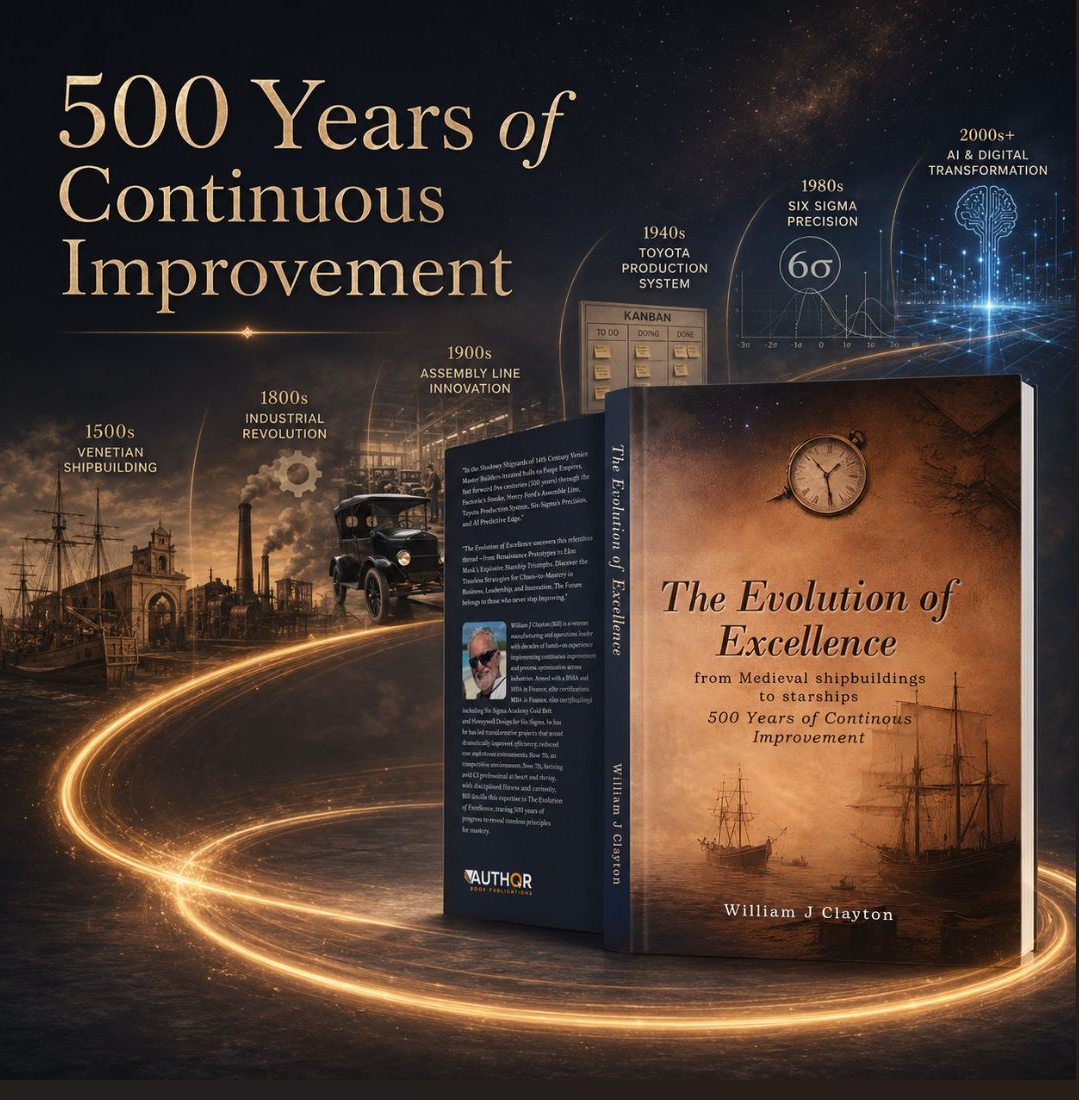
“Five centuries of innovation reveal a timeless truth: every breakthrough begins as an improvement upon what came before.”
— William J. Clayton
With decades of experience leading operational excellence initiatives, I help organizations turn complexity into clarity, efficiency, and measurable results.
I hold an MBA in finance and a Six Sigma Master Black Belt. Over the years, I’ve worked with teams across industries to strip away complexity, strengthen processes, and build cultures where improvement becomes a daily habit rather than a one-time project.
After retiring from aerospace operations, I transitioned my passion for continuous improvement to the Arizona Department of Transportation (ADOT), where I serve as a Lean Coach helping teams improve processes, solve problems, and better serve Arizona’s citizens.
Yet the more I taught and practiced these principles, the more I found myself asking a fundamental question:
- Where did continuous improvement truly begin?
- Where did the mindset of “make it better” first emerge as a disciplined and repeatable practice?
Rather than starting with the familiar modern tools of Lean, Six Sigma, or Agile, I decided to look back and ended up at the 500-year mark.
That curiosity became a multi-year journey of research and writing. I followed the thread of improvement from the disciplined shipyards, guilds, and cottage industry of the late Middle Ages, through the precision of Venice’s Arsenal, the rise of the industrial age, the assembly lines of Henry Ford, the revolutionary thinking of Toyota, and all the way to the rapid iteration practiced at companies like SpaceX and Tesla.
Along the way, I discovered that the core ideas we now call continuous improvement are far older — and far more powerful — than most of us realize.
The result of that journey is my book, The Evolution of Excellence: From Medieval Shipbuilding to Starships — 500 Years of Continuous Improvement.
In its pages, I show that excellence has never been accidental. It is built, refined, tested, and deliberately passed forward, generation after generation. The same patterns that allowed medieval shipwrights to steadily improve their craft still drive breakthrough performance today.
This newsletter is my way of continuing the conversation the book began. Each month, I will share practical insights, historical lessons, and modern applications of continuous improvement that you can use in your own work and leadership.
Whether you are a seasoned practitioner, a leader driving change, or simply someone who believes there is always a better way, I hope these ideas prove useful.
Thank you for joining me. I’m glad you’re here.
— William
In this first issue, I want to give you a clear roadmap for the months ahead.
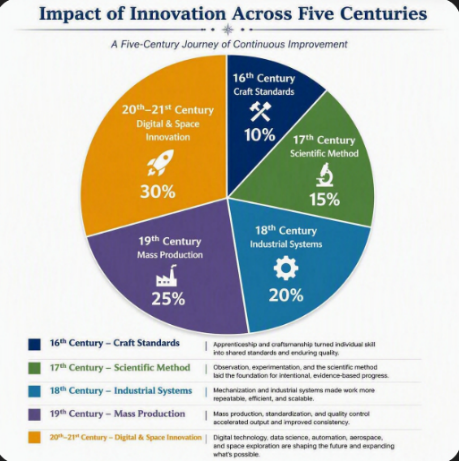
The Evolution of Continuous Improvement
The pie chart illustrates how the impact of continuous improvement has grown and evolved across five centuries. Each segment represents the relative contribution of that era’s breakthroughs to the overall progress we see today.
The percentages are not precise measurements of history — they are a visual way to show how the scale and influence of systematic improvement have expanded over time.
16th Century – Craft Standards (10%)
Apprenticeship and craftsmanship began turning individual skill into shared standards and reliable systems. Excellence was still largely personal, but the foundations of knowledge transfer were being laid.
17th Century – Scientific Method (15%)
Observation, experimentation, and the scientific method became formal tools. Improvement moved from tradition and intuition toward evidence and deliberate testing.
18th Century – Industrial Systems (20%)
Standardization of processes and machinery created the first truly scalable systems. Efficiency and reliability could now be designed rather than simply hoped for.
19th Century – Mass Production (25%)
Assembly lines and interchangeable parts transformed manufacturing. High-volume, consistent output became possible, and the modern idea of process improvement took clearer shape.
20th–21st Century – Digital & Space Innovation (30%)
Computing, automation, data, and space exploration have dramatically expanded the frontier. Continuous improvement now operates at speeds and scales unimaginable in earlier eras.
Over the coming months, we will walk through each of these eras in turn.
I will share key stories, the methods that emerged, the leaders and builders who drove change, and — most importantly — the practical lessons that still apply to the challenges we face today in business, government, and technology.
My goal is simple: to help you see continuous improvement not as a modern toolkit, but as a 500-year human tradition that is still unfolding.
Each issue will give you both historical insight and actionable ideas you can use in your own work.
Thank you for being part of this journey.
The next issue will take us into the shipyards and guild halls of the 16th century — where the story of systematic excellence begins.
— William