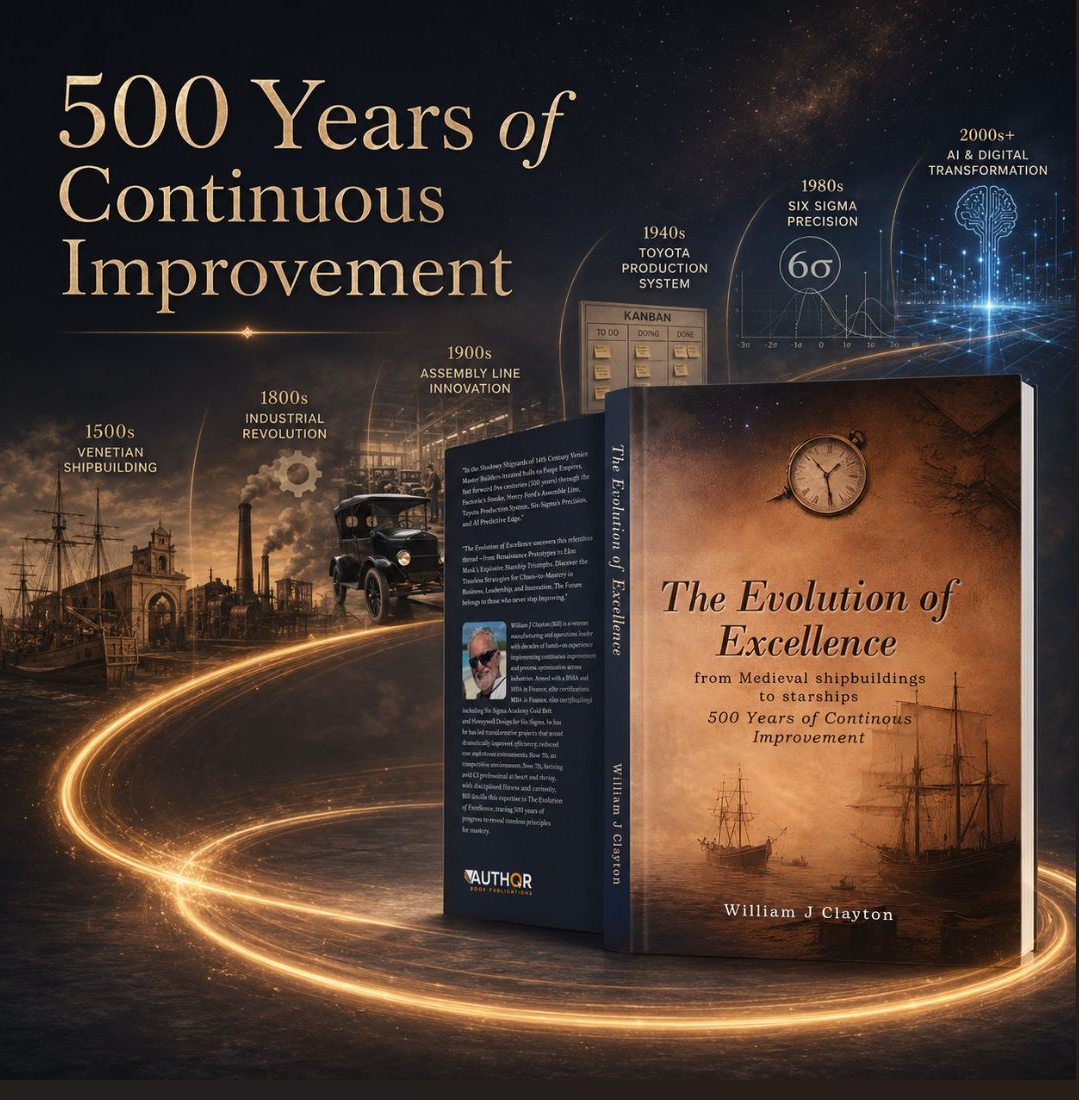
William J. Clayton’s compelling study of 500 years of continuous improvement, from medieval shipyards to the age of starships
Few books attempt to connect the craftsmanship of medieval shipbuilders with the technical sophistication of modern spacecraft. Fewer still do so through the disciplined lens of continuous improvement. In The Evolution of Excellence: From Medieval Shipbuilding to Starships — 500 Years of Continuous Improvement, William J. Clayton offers an ambitious and timely exploration of how human progress is built: not through isolated flashes of genius alone, but through centuries of accumulated knowledge, iterative refinement, and purposeful innovation.
Clayton positions excellence as an evolving historical process. Beginning with the traditions of ship construction and extending toward aerospace engineering and imagined futures beyond Earth, the book examines how tools, materials, design practices, labor systems, and organizational learning have advanced over time. The result is both a readable historical narrative and a serious study of improvement as a cultural, technical, and managerial phenomenon.
What makes The Evolution of Excellence especially valuable is its broad interdisciplinary reach. Readers will find themes relevant to maritime history, industrial development, engineering practice, quality management, systems thinking, and leadership. Clayton demonstrates that progress depends on more than invention; it requires observation, testing, correction, documentation, and the willingness to improve inherited methods. In this sense, the book speaks directly to today’s organizations seeking to build better products, stronger teams, and more resilient processes.
As an author, William J. Clayton brings clarity, scope, and intellectual curiosity to a subject that spans centuries. His central achievement is to show how the pursuit of excellence links generations of builders, engineers, craftsmen, managers, and visionaries. By moving from wooden vessels to advanced spacecraft, Clayton gives readers a powerful framework for understanding innovation as continuity rather than rupture: each new frontier rests on the lessons, failures, and refinements of the past.
This is a book for readers who want history with practical relevance. Engineers, executives, educators, students, manufacturing professionals, quality leaders, aerospace enthusiasts, and anyone interested in innovation will find in Clayton’s work a persuasive argument for the enduring value of continuous improvement. The book does not merely describe progress; it invites readers to adopt the habits of excellence that make progress possible.
The Evolution of Excellence is both a tribute to human ingenuity and a practical reminder that the future is shaped by those who keep improving the present. From medieval shipyards to starships, William J. Clayton has written a book that is expansive in scope, accessible in style, and highly relevant to the challenges of modern innovation. For anyone committed to building better systems, better organizations, or better futures, this is a work worth reading, discussing, and returning to.